Sunday, August 28, 2005

Recipe Korner: Yarrow

Yarrow

Yarrow has long been used in China and made into poultices from early times in order to stop bleeding (including menstrual and hemorrhoidal ailments), stop infections, and heal bruises and wounds. In China, yarrow is called “shicao” and the dried yarrow stems were used in fortunetelling or what is called I Ching. In addition, the early Chinese brewed the perennial yarrow herb into a tea for use as an antibiotic, headaches, fevers, colds, and the flu. The wonderful healing properties of this natural herb helps to curb diarrhea, anemia, gas, and lower blood pressure.

As a tea, yarrow causes sweating which helps to reduce fever and dilates the blood vessels near the surface of the skin helping to lower blood pressure. Fresh leaves were chewed to stop toothaches too. Yarrow can be found growing in parts of Asia, North America, and Europe; it is believed to have been around for approximately 3,000 years. Yarrow has many more healing properties and uses which one can study more about on their own.


Suggested Adult Dosages:

Dried herb: 2-4 grams as an infusion or in capsules 3 times per day
Extract (1:1, 25% grain alcohol): 1 to 4 ml three times per day
Tincture (1:5, 40% grain alcohol): 2 to 4 ml three times per day
Yarrow flower: 3 grams per day as an infusion or tea
Sitz bath: 100 grams yarrow per 5 gallons of water

Yarrow Poultice:

Add 1-cup each of fresh yarrow and comfrey leaves to a blender or food processor; add just enough spring water to blend the leaves into a paste; apply the paste to the bruised or wounded area then cover with a cloth for 20-30 minutes. The yarrow paste helps as a hemostatic or bloodclotter.

Yarrow Tea:

Steep 1-tablespoon of fresh leaves & flowers in 1-cup of boiling water, cover for 3-4 minutes; drink a cup twice per day. If you use dried yarrow leaves, then steep 1-teaspoon. Add some honey to the yarrow tea as a sweetener.

Note:

Excessive intake of yarrow tea may prevent your body from absorbing iron; so do not overdo this tea.

__________________________
Kheti Metaphysical Institute

Friday, August 26, 2005

Recipe Korner: Clove Tincture

I. Clove Tincture

This is a soothing clove tincture remedy until you can visit with your dentist:

If you have a toothache, then add 4 clove buds (leaves if buds are not available) to 1-ounce of gin; shake the mixture for 2-3 minutes; then swab the sore or painful area with this tincture as needed.

DO NOT DRINK!!!!!

In addition, clove will help in decreasing infection of decaying tooth.

Oil of clove or clove oil (Eugenia caryophallata) has a sweet, spicy taste and comes from the clove bud. It is also used to relieve toothaches; however, one should be very careful using full strength clove oil because it can damage the nerves of the tooth and it is a potential irritant to sensitive skin. Always dilute clove oil. Add 1-2 drops of clove oil to a teaspoon of extra virgin olive oil, mix well, then swab the sore or painful area as needed

II. Clove Rubbing Oil

To make an anodyne (analgesic) rubbing or massage oil, add the above mixture (tincture) to 1/2 - 1 cup of oil extra virgin oil, mix well then apply to soothe achy muscles.

DO NOT DRINK!!!!!
________________________________________
Dr. Kheti A. Sahure, Msc.D.,
Herbalist & Metaphysician
Kheti Metaphysical Institute

Wednesday, August 24, 2005

Egyptian Palm Branch

Egyptian Palm Branch

Ancient Egyptian royal scribes would etch a notch in a palm branch (usually with a scribe's pen) to signify the passing of a year in the life and reign of a pharaoh; the branch was also used to measure the passing of time, record the number of goods and captives brought back after a pharaoh's military campaigns. Seshat, the Goddess of writing and measurement, mathematics, architecture, and record-keeping, shared many of these duties with Thoth. The palm branch was shaped into the form of a scepter or staff from the central rib of the date palm tree. The base of the branch often bore the tadpole hieroglyph which represented "100,000" and the shen ring hieroglyph which represented "eternity or infinity". Days were represented by the lotus hieroglyph, months by the moon hieroglyph, and years by the entire palm branch.
__________________________
Kheti Metaphysical Institute

Friday, August 19, 2005

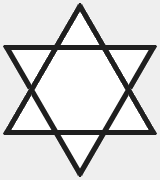
The Hexagram

The Hexagram is a magickal geometric shape (hexagon) made up of a 6-pointed star; it is also known as or called the Symbol of the Macrocosm, Signet of the Macrocosm, or "Star of David". There are two overlapping (some interlocking) triangles, one up and one down. The upward-pointing triangle represents man and the downward-pointing triangle represents woman, thus representing the spiritual balance between masculine and feminine. The upward triangle corresponds with fire and the downward corresponds with water. A hexagram with a circle around it is known as the "Star of Solomon" or the "Seal of Solomon" (when used in Ritual Magick).

The hexagram has been used for many spiritual purposes from ancient times to the present very similar to how the pentacle and the pentagram are used in ritual magick for protection, cast as a circle, and to represent the Divine Union between masculine, feminine, earth, air, water, and fire. Some of the hexagram's usages include: Lesser Ritual of the Hexagram, Greater Ritual of the Hexagram, Thelemic/Hermetic, Gematria and other forms of Divination, Invocation, and Banishment.

_________________
The Temple of Kheti

Thursday, August 18, 2005

Mysticism: Living in Depth


Mysticism: Living in Depth
by
Rev. K.A. Sahure, H.P.
The Temple of Kheti

Mysticism shares a common interconnection between transcendent levels of reality, thaumaturgy (performing miracles via magick), theurgy (persuading supernatural forces to engage their powers), science, prayer and worship, and spirituality. As a metaphysical discipline, mysticism comprises a basis of both praxis (i.e., technique, practice, and practical application of theory) and gnosis (i.e., esoteric spiritual knowledge—not in reference to the "Nag Hammadi Papyri"/codices of Gnostic scriptures). These transcendent levels of reality and associations within mysticism are not unidimensional.

Something to ponder and to be continued . . .

▲ Ankh udja seneb ▲