Friday, March 9, 2012

Kyphi (Kapet)
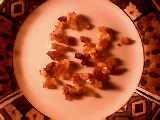 Daily in Ancient Egyptian ritual, Kyphi was and remains a dedicant to the Goddess Aset (Isis) where frankincense was burned during the morning, myrrh during the day, and Kapet (Kyphi from the Greek translation) during the evening. Depending upon the recipe, Kyphi is primarily a blend of myrrh, frankincense, copal, and benzoin. This blend smells wonderful; it helps create a very rich and mystickal atmosphere during ritual for me. You can make your own blends in oil, resin, and paste forms to be used as incense during Moon rituals, spellcasting, divination, prayer, and aromatherapy.
 Kyphi in oil form can be used to increase circulation, relieve tension, and stress. As a side note, Queen Hatshepsut (c. 1472–58 BCE) formed expeditions to bring back processed myrrh and living myrrh trees to Egypt to adornthe foreground of her Dayr al-Bahrî temple (Hatshepsut Temple) in western Thebes. Many ritual blend recipes can be found on the temple walls at Edfu and Philae to this day.
The three important ancient Kyphi blends are:
Dioscorides
Edfu
Galen
There are several excellent websites devoted to these blends and their history which anyone can research and find for more information.
______________________
Temple of Kemetic Wicca


Thursday, March 8, 2012
The Law of Three
The Law of Three (Threefold Law or Law of Return) and Karma are very much related within the Universe. Therefore, whatever you do or whatever energies you put or emit into your environment will return to you threefold or three times over.
Can we as practitioners of the Craft influence, change (manipulate), or manage these Karmic energies or forces?
Based on the natural Laws of Physics, spiritual energies do have substance as electrical forces within nature and the universe.
Per Wikipedia [Wikipedia contributors, "Rule of Three (Wicca)," Wikipedia, The Free Encyclopedia, http://en.wikipedia.org/w/index.php?title=Rule_of_Three_(Wicca)&oldid=458377879(accessed March 8, 2012).]:
And the debate continues...
Can we as practitioners of the Craft influence, change (manipulate), or manage these Karmic energies or forces?
Based on the natural Laws of Physics, spiritual energies do have substance as electrical forces within nature and the universe.
Per Wikipedia [Wikipedia contributors, "Rule of Three (Wicca)," Wikipedia, The Free Encyclopedia, http://en.wikipedia.org/w/index.php?title=Rule_of_Three_(Wicca)&oldid=458377879(accessed March 8, 2012).]:
The Rule of Three (also Three-fold Law or Law of Return) is a religious tenet held by some Wiccans. It states that whatever energy a person puts out into the world, be it positive or negative, will be returned to that person three times. Some subscribe to a variant of this law in which return is not necessarily threefold.[1][2]
The 'Rule of Three' is sometimes described as karma by Wiccans, however this is not strictly accurate. Both concepts describe the process of cause and effect and often encourage the individual to act in a good way. However the concept of karma, according to the scriptures ofBuddhism, Hinduism and other eastern belief systems, does not operate on a system of three-fold return. Furthermore, such belief systems do not contain the same concepts of 'good' and 'evil' that Wicca does.
According to John Coughlin the Law posits "a literal reward or punishment tied to one's actions, particularly when it comes to working magic".[3] The law is not a universal article of faith among Wiccans, and "there are many Wiccans, experienced and new alike, who view the Law of Return as an over-elaboration on the Wiccan Rede."[3] Some Wiccans believe that it is a modern innovation based on Christianmorality.[4][5]
The Rule of Three has been compared by Karl Lembke to other ethics of reciprocity, such as the concept of karma in Dharmic religionsand the Christian edict, "Do unto others as you would have them do unto you" (Matthew 7:12 ), also called the "Golden Rule."
The Rule of Three has a possible prototype in a piece of Wiccan liturgy which first appeared in print in Gerald Gardner's 1949 novel High Magic's Aid:[6][7]
'Thou hast obeyed the Law. But mark well, when thou receivest good, so equally art bound to return good threefold.' (For this is the joke in witchcraft, the witch knows, though the initiate does not, that she will get three times what she gave, so she does not strike hard.)
The first published reference to the Rule of Three as a general ethical principle may be from Raymond Buckland, in a 1968 article for Beyondmagazine.[8] The Rule of Three later features within a poem of 26 couplets titled "Rede of the Wiccae", published by Lady Gwen Thompson in 1975 in Green Egg vol. 8, no. 69[9] and attributed to her grandmother Adriana Porter.[10][11] The threefold rule is referenced often by the neo-Wiccans of the Clan Mackenzie in the S.M. Stirling Emberverse novels.
This rule was described by the Dutch metal band Nemesea, in the song "Threefold Law", from the album "Mana".
And the debate continues...
Saturday, February 25, 2012
Subscribe to:
Posts (Atom)